STEAM Point Racing
Where science and racing meet. We're turning high-performance motorsports into a real-world laboratory, breaking down friction, force, airflow, motion and more!
The Science
We're connecting science and racing! There's a link to YouTube and a blog post under each topic below, so you can learn about science your way!
- - - - - - - - - - - - - - - - - - - - - - - -
The Racing
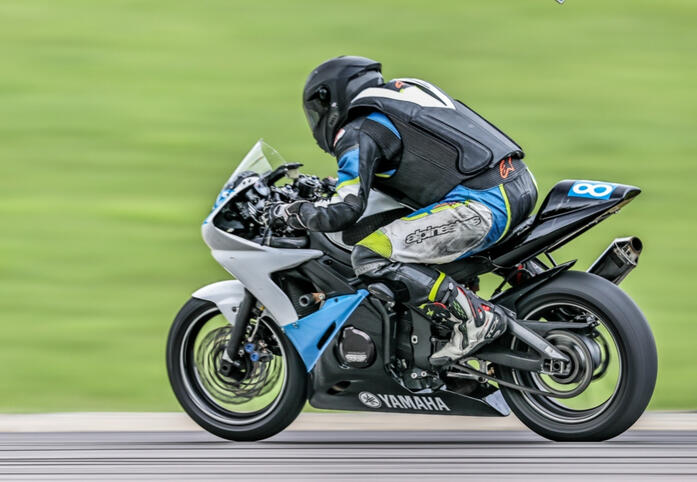
We're a grassroots motorcycle road racing team, with decades of racing experience. The bike is a 2004 Yamaha R6 in a mostly stock configuration.The focus is endurance racing, where the races last anywhere from 2 to 6 hours.2026 Schedule:
May 23 - ASRA 2 hour race
Summit Point, WVSept 12 - ASRA 2 hour race
Blackhawk Farms RacewayOct 16 - ASRA 2.5 hour race
Daytona Intl Speedway
Energy in Motion

You’ve heard me say “The faster you go, the louder the science.” What does that actually mean? Let me explain.KE = ½ mv²This is kinetic energy. Kinetic energy equals one-half mass times velocity squared. Mass and weight aren’t exactly the same but for the forces involved in racing here on earth, we can use them the same way. Mass is actually the volume of stuff that you’re made of, where weight is how hard gravity is pulling on that stuff. Your mass is the same whether you’re on the earth or moon, but your weight is very different.Velocity isn’t just how fast you’re going, it’s also in what direction. You could be walking 4mph north then turn and walk 4mph east. Your speed stayed the same but your velocity changed, because your direction changed.Now let’s go back to our kinetic energy equation, remember how velocity is squared? That part matters. Double your speed, and your energy goes up four times. That’s four times more energy your tires and brakes have to deal with. Let's say your speed goes up 3x, maybe from 50mph to 150. Now your kinetic energy is going up 9x!When grip stays the same, stopping distance follows that energy. More energy in the bike means it takes more distance to get the energy back out. So doubling speed roughly means four times the braking distance. It’s not courage—it’s math. Air works the same way.Fdrag = ½ p u2 cdrag AThe force from air resistance depends on velocity squared too. Let’s put that formula into words.Force(drag) = ½ (air density)(velocity)²(coefficient of drag)(frontal area)When you double your speed, the density of the air, shape and size of the bike all stay the same—but since velocity is squared here too, the air pushes back four times harder. To beat that air, you need power. Power equals force times speed.Power = Force x velocityThe force of drag goes up with velocity squared, then you multiply by velocity again so power needed goes up with speed cubed. Double the speed, you’ll need about 8x the power. Triple your speed, you'd need 27x the power! At low speed power helps you accelerate but once you’re going fast, most of the power you're using is so you don’t slow down.Distance = speed x timeEven mistakes scale with speed. Distance traveled is just speed times time. Take a reaction time that's 0.1 second too slow , and you might have missed a braking point or apex by a few feet. Same reaction time at double the speed, doubles the distance—all while having four times the energy.So at low speeds, all of the grip, power, and science is still there, but it's quiet. They all go up with speed, and that's what we mean by the faster you go, the louder the science.
Learn More
Partnership Opportunities
Coordinate Live Demos
Questions or Comments
Boyle's Law in Action

When a motorcycle goes down the track, the air doesn't just go around the bike - some actually goes through the bike. We're going to follow the air through the bike and find out what's going on in there.Air starts its journey swirling around the race track, getting pushed and pulled by the motorcycles riding by. Most of the air goes around the bike, but some of the air gets sucked into the bike to make the motorcycle go! The air that gets sucked in has to clean up first. The air around the track is dirty, it’s got bits of dust, dirt, and even rubber floating around. If the dirt gets inside the engine, it will have a bad time, so the air filter catches it.The air filter has tiny holes all throughout it. The holes are big enough for the air molecules to sneak though, but too small for the dirt and dust that could hurt the engine. It’s there to make sure the air is as clean as possible before it continues its journey through the engine.We’re ready for The Intake Stroke. The piston is at the top of the stroke and the intake valve opens up. It’s time for Boyle’s Law to come into action. Boyle’s Law explains that increasing volume will decrease pressure, and decreasing volume will increase pressure, as long as the temperature and amount of gas stay the same.
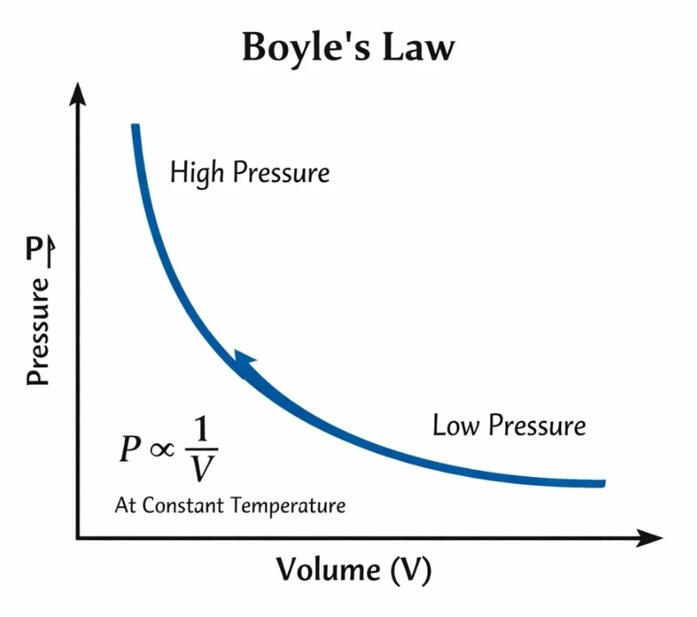
As the piston goes down and the intake valve is open, the volume or space inside the cylinder increases. Increasing volume means decreasing pressure. Air naturally wants to move from high pressure (outside the engine) to low pressure (inside), so the cylinder fills up with air. As the air is making its way into the cylinder, we spray some fuel in too - this will be important in the next step!Once the piston gets to the bottom of the stroke, the intake valve closes and all those clean air molecules are trapped inside. There’s nowhere for them to go! This is The Compression Stroke. As the piston starts to make its way back up, we start to build compression. The piston is squeezing the air and fuel inside the engine.It’s Boyle’s Law again. Since the valves are closed, we're taking the same amount of air and fuel that we just sucked into the engine, and pressing it into less and less space, which increases pressure.
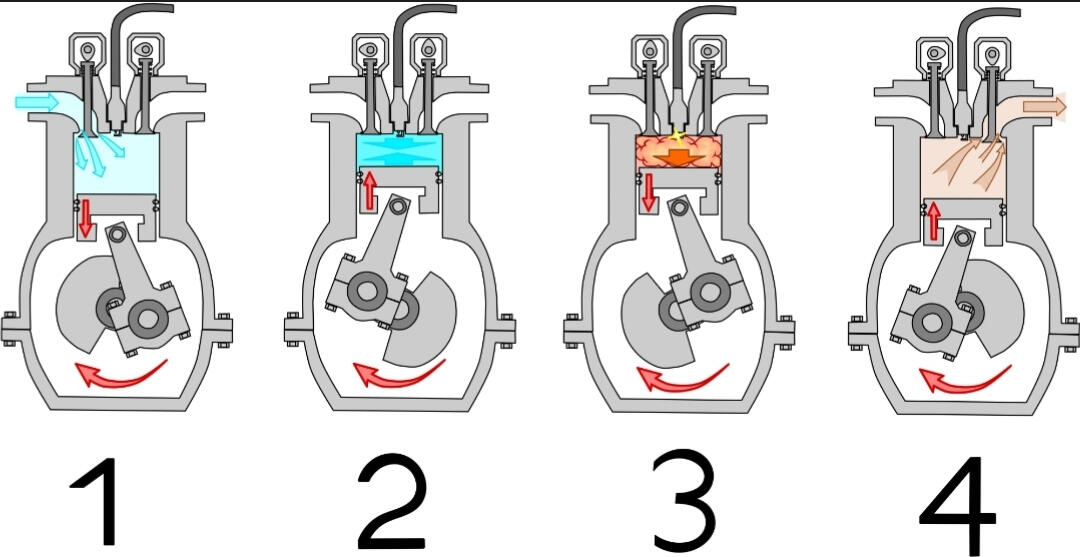
The Combustion Stroke is when the spark plug ignites the compressed air-fuel mixture, a chemical reaction begins - fast. The fuel releases stored chemical potential energy which turns into heat and expanding gas, or combustion. The heat from combustion makes the gas molecules move faster, and the faster-moving molecules spread out which creates even higher pressure. That pressure pushes down on the piston to become mechanical motion, it’s what creates the 3rd stroke in our 4 stroke engine.That air and fuel can only explode once. The explosion rearranges the molecules to become a new gas that gets pushed out of the engine. Last time the piston went up, both valves were closed and we increased pressure. This time, the exhaust valve is open so as the piston rises the exhaust gasses have a place to go.This is The Exhaust Stroke, and Boyle's Law is in action again. This time, the piston is going up and the volume of the cylinder is decreasing, but the air has a place to go - the valve is open! The pressure goes up, like we expect but it flows through the exhaust valve towards the lower pressure air outside the engine.The exhaust gas is pushed out of the engine, through the exhaust pipe and out of the muffler completing its journey through the motorcycle. It’s not air anymore, but it’s still a gas that helped just for a brief moment push the bike forward.So here’s the STEAM Point. During each movement of the piston, Boyle’s law was in action in a different way:
There was an intake stroke when air and fuel were pushed into the engine
Then we had a compression stroke to squeeze the air and fuel.
Next was the combustion stroke to turn the fuel into power.
Last we had the exhaust stroke to get the old gas out and make room for new gas.
If you combine the right amount of air and fuel, and light it at exactly the right time you can release energy that the motorcycle uses to go fast. You know what happens the faster you go? The louder the science!
What Is STEAM?

Have you ever wondered how science, technology, engineering, art, and math, or STEAM, come together in real life? We’re using motorsports to find out. This is STEAM Point, where science and racing meet.Science is the study of the structure and behavior of the world through observation, experimentation, and the testing of theories against the evidence. Motorsports is really just a big science experiment. We have ideas about how to go faster, we test those theories and write down the results.Technology is the application of scientific knowledge for practical purposes. In our case - racing. There have been centuries of innovation from the wheel, to metallurgy, horse drawn carriages. All of those led to the cars and bikes we see today, and none of it could have happened without the knowledge that came before it.Engineering is where science and technology combine. It’s where we figure out how to design and build the machines, race tracks, the parts and pieces all for maximum performance.Art is a funny one. Usually it’s defined as the expression of human creative skill and imagination, usually in a visual form but we can think about it a different way. Problem solving is something we do every day, and it’s not just data driven. We have to use imagination to connect ideas or thoughts that weren’t previously connected. That’s art too!Math is where we use numbers and patterns to figure out how things work. We use math all the time in racing - to calculate fuel mileage, gear ratios, even budgeting how much racing we can afford to do in a season!STEAM is everywhere you look in motorsports, and we’re going to look all over the world of motorsports to see how the faster you go, the louder the science.
Getting in Gear

In racing, your engine is a tool, and like any tool, it has a specific range where it works best. When we were at Daytona, we needed the bike to be geared for the long straightaways. At a more technical track like Kershaw, top speed doesn't win races, acceleration out of the corners does. To change how the bike moves, we don't necessarily need a bigger engine (although it would be nice); we need better leverage. This is STEAM Point, where science and racing meet.When I was reviewing video from my last race at Kershaw, I noticed my max RPM was only 12,000 RPM at the end of the straightaway. Redline on the bike is 16,000 which tells me I could have accelerated harder out of the corner. I had top speed available, but the track wasn’t long enough for me to get there.Last race here, I had a 16 tooth sprocket on the engine - same as what came from Yamaha 20 years ago. This year I’m going to try a 15 tooth on the front.To understand a gear set, you have to think of it as a continuous lever. When you use a wrench to loosen a bolt, you are applying force at a distance from the center. This creates torque, which is the rotating equivalent of linear force.The rear sprocket on a motorcycle acts exactly like that wrench. The "length" of the wrench is the radius of the sprocket. If we install a larger rear sprocket, it’s kind of like using a longer wrench.The formula for torque is the product of the force and the distance from the pivot point: Torque = Distance × ForceBy increasing the radius of the sprocket, the engine's force is multiplied, allowing it to turn the rear wheel with much more authority but there’s always a tradeoff. To figure out how much "help" we are giving the engine, we calculate the Gear Ratio. This is the relationship between the input (front sprocket) and the output (rear sprocket).At Daytona, we ran a 17-tooth front and a 46-tooth rear. 17:46 = 2.71For Kershaw, we are dropping to a 15-tooth front and keeping the 46-tooth rear. 15:46 = 3.07By changing the front sprocket, we have increased our mechanical advantage. This change gives us a 13% increase in torque at the rear wheel.There’s always a tradeoff though, by increasing torque we are decreasing the ability to hit a top speed. We will get to speed quicker, but the top speed itself won’t be as high. This is a good tradeoff this time, because the track we’re going to isn’t as long. Outright top speed isn’t as important. Staying in the PowerbandWhy not just use the "acceleration" gears everywhere? Because engines have a Powerband, or a specific range of RPM where the engine produces its maximum torque.If our gears are too "tall" for a track, the engine might struggle to reach those high RPMs against the wind resistance. If our gears are too "short,” we might run out of RPMs before we reach the end of the straightaway.By changing the gears, we are ensuring that when I twist the throttle exiting a turn, the engine is exactly where it produces the most force.We’ve traded the ability to go 160 mph for the ability to get to 140 mph much faster. In racing, and in science, every gain comes with a calculated trade-off. It’s another reason the faster you go, the louder the science.